
Content warnings: transphobia, homophobia, veiled racism, smoking, the UK.
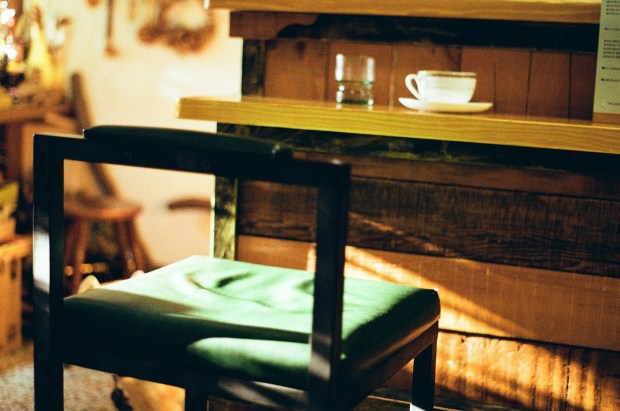
She takes a seat on the plush olive cushion on the folding-chairs in the café, the kind you’d force yourself into for school assembly, and orders kippers and buttered soldiers. Her friend’s armchair was, is, positioned to the street window where now there are high-stools, a wooden bench at elbow height and pots of sugar, salt, pepper. If there’s someone sitting in the chair, she thinks, I can’t make them out. Her friend had a taste for the dramatic, would rise up from her chair facing the street, the church steeple slightly visible over the florist directly opposite, and greet her like an unexpected surprise, regardless of whatever plans they’d made.
The man behind the counter, she is certain now, is one of them. A changeling who came in with the silvery-blue light she’d seen above the fields. He looks at her from over the head of the espresso machine when he thinks she isn’t looking. There’s nothing visually alien about him, like the others. Perfectly normal, with a short-shorn bright red beard and a pleasantly musical voice she’d often heard behind her at the carpark of the Tesco’s.
She checks the phone on psychic impulse — her daughter Evie handed it to her, visiting from London, when she got a new one; Evie despaired at getting in contact with her – as the kippers arrived in her friend’s old living room, brought by the man who wasn’t a man. His hands, she thinks briefly, are suckerish, metallic, or feathery, just under the surface. His eyes are twinkling like stars; he’s still young after a million-year journey.
But she has no messages. She drops the phone back into her handbag, a unique piece crafted by a local designer decades ago and decorated with the images of the local scarlet pimpernel flowers. She’s written out her name in cursive inside.
She suddenly feels short of breath, a copper taste under her tongue. She hears the crackle-fizz of her friend’s old toaster. Enjoy your meal, she thinks she hears, but could be wrong. There could be something in the light, too, something extra to take root in your head, to soften up observers for the culmination of the plan yet to be drawn against us.
She cuts the kipper into tight fifths and forks it with a slice of burnt bread. Her friend is still invisible in the big chair – I’ll see her in a second – as the not-man walks away, over her friend’s rug, to bring a croissant to a family at a linoleum table. She thinks, when there wasn’t a table here – why would someone put a table here? – they’d sit on the carpet together and drink brandy. It would be midnight, only one lamp in the street, nothing on telly but the shipping.
We’d be naked except for the duvet. Still feel her mouth on my collarbones, kissing her way down, brandy lips. There could be snow, or it could be Easter. Naming me and my limbs, like the beginning of the world. Lips, peach. Eyes, brown. Divot in my hip and leg. Fingers in my clunge. We’d laugh, breathily. Try and up ourselves. Minge. Fanny. Front-bottom. Waking up the neighbours with hymns sung, call and response.
The sudden harsh vibe of the phone (some days she still feels like it isn’t hers), shocks her into place. Her granddaughter is visiting today. She smiles, then frowns. Her memory is getting worse, it seems, or her past is taking hold of her more often than she’d like. Maybe it’s another symptom of the body snatchers’ astral incursion? Like the way that people went blind from that comet just before the triffids started growing wild and taking over…
She forks the last bite of the kippers into her mouth, savouring the smoky taste, while fishing around in her bag to retrieve her phone and check her granddaughter’s text:
Hey gran, bus is coming in in half an hour! Will u be at home? 🙂
She stands up from the table, pushing the chair in as she goes before she even thinks of leaving. Even with her eyes glued to her phone she’s conscious of the space she’s in and everyone around her. She whispers the sacred words as she wipes down the spot under the plate with a spare tissue, says thank you as the not-a-man takes it up for her. She runs her hand down the solidity of her friend’s doorframe, holding the portal open for someone who looks like a neighbour. “Thanks, love,” the maybe-friend says, smiling toothily. Need to send a message back. She looks around the high street for symbols. The church with the carving of the Egyptian Aten dug into the keystone. The pub sign of St Dunstan clamping the Devil’s tongue in a pair of pliers. The wine bar that used to be the Royal Post.
I will ☺ see you then my sunshine!!!
She walks past her house. She remembers her friend telling her they filmed one of the Quartermass specials around the green. She couldn’t remember which one. They all get blended up: there’s a pit where the basketball court is which no one uses for basketball. There are ghosts of people that appear in the skate park, here’s them scraping their knee on the ramp, here they are kissing under the wooden struts, here’s someone carving a swastika. In the distance, she can see a tower her friend used to think was some kind of isolated monastery – where they hid all the perverts, she giggled – which she later found out was an all-boys private school and is now a nursing home.
Can’t wait, see you there! ❤
She shivers as a cold wind blows in from across the green. The sky is overcast, but blue under the long whiskers of cloud. Flirting with a cool, but sunny day. On mornings such as this, she and her friend would often go on picnics. Trusting that the other villagers would still be hiding from their memories of bleak and icy midwinters. Giving them a moment’s space to be alone together, running their fingers along each other’s palms, tentatively, as if the air would moan too loudly and they’d have to spring apart.
She knows she’s dawdling but she’s sure she has time. Even with the body snatchers terraforming everything to suit their alien biologies in preparation for the fleet of more unsubtle colonisers that she’s sure will come. The lingering shadows hanging like a shroud over the ancient stone and woodwork. She finds a lot of comfort in the physicality of this place. The air still feels the same way it did when she was younger. The streets are busier, but no less quiet. She knows that life is movement. Death is stasis. But she wishes she was better at seeing the beauty in changes she didn’t understand.
She did see lots of beauty in her granddaughter. The way her smile broke out across her face like the sun over the green on a summer day. How she’d grown so much to resemble her mother. There’s an alternate universe where her mother’s eyes resemble her daughter’s smile more closely, without the heaviness they took on after – what was his name? An alien bioweapon surely: it was put in her food, in her water, in her kisses. It made her sad.
She loved the way her granddaughter was able to love freely. She only saw her through her pictures on her Facebook. Smiling beside other women she was proudly in relationships with, whose photos she would always give a care react to. Leave a comment saying how happy she looked. How beautiful she was. Holding a secret, my hands would shake.
At the bottom of the hill there’s a path, past the in-common vegetable patch, the children’s play equipment on the right. She and her friend would take this path at night, hand-in-hand into a black mass. When I was younger, she remembers, I was playing on the bars, trying to hold on. I looked past my hands slipping and I saw an old lady, walking past the fence, toward the big green thicket. I knew it was me, I knew it would be me. I let go in shock.
She looks toward the mass, bare in the light, path sloping beneath her good shoes. She shakes her head, turns back, not before noticing the flying saucers approaching over the horizon, silver scales and heat-rays glittering. Hurriedly, she looks back. They’re just clouds, big cumulonimbus clouds. Unusually bulbous. Heralding nothing but approaching rain, she reassures herself in her radio-voice. She hurries past the goodwill clothes bin and the glass recycling, colliding with her friend—
“Gran?”
Her friend was unusually tall for a woman. Casual and comfortable, always effortlessly fashionable. Her blouse would hang open around her collarbones. The way it fluttered when she laughed. A guttural sound, filling her body from the bottom up. Her granddaughter has the same aura: a scarf thrown over her shoulder with casual nonchalance, a slouching stance, which would look lazy on a girl who did it without her intensity. A ring in her nose, several others in her ears, like little doorknockers, reminding her of the old milkman. Larry was his name. A nice young man. Until the body snatchers took him too. The same way they inevitably take us all.
Her granddaughter puts her arms around her suddenly, tears welling up around her subtly wing-lined eyes. They’re green-blue, like the sea.
“I’ve missed you so, so much,” she says.
It’s not you, surely not you. She returns the embrace.
“Jeez, Gran,” she laughs. “You’ve missed me too, I get it.”
“You’re Daisy, after that song you like. Ash-someone…”
Daisy’s hair is blue, like the sky behind the clouds. She relaxes her grasp on her a little, tentatively. “Yeah, Gran, that’s me,” Daisy says. She looks in her eyes. “You okay?”
There’s a hum above their heads, an interstellar engine.
“Yes, sweet, yes. What am I doing here?”
“You always come here, Gran,” Daisy responds, still tentative. “It’s your regular walk.”
Her friend’s eyes were ruddy, like old leaves. The closer you got to her face, they went from crinkled brown, to amber, to almost maroon. Like the seasons, she thought.
“I didn’t think I had a regular walk.”
“You do, Gran, Mum mentions it.”
She looks around at the trees, on the road back to the high street. There are little men with bulbous heads behind the trunks, watching her, eyes like headlamps on a milk truck.
“I didn’t think so,” she replies.
They pass The Middle House; on the sign, St Dunstan is hammering the devil’s tongue in a pair of tongs. She hears it striking twelve on the anvil above her. The devil looks like a little goat that learned to walk; it took a lot of time, she feels. The hammer echoes, the hum of the ship is above her. Why today? Why have they focused on her now?
“Gran, can I get you tea when we’re back inside?” she says. Tentative, always tentative. Like a little deer.
“You always made me tea, it was always very nice of you.”
They were approaching the door of her house, always the same house.
“Gran, I’ve never made you tea,” she says, giggling slightly.
The threshold was approaching them.
“Of course you have. You’ve always done it. You’re doing it now. You always will. Time is silly like that, Heather.”
“Gran, my name is Daisy,” Daisy says, her voice no longer tentative, “Like the flower. I picked it myself.” Daisy laughs a little again. “Common joke in my circles.”
“Yes dear. It’s a beautiful name. Just like you.” The threshold arrives. The hum is growing louder, deafening. The hissing of the kettle. It should be shaking the street to its roots, she thinks. There’s a light above her, drawing her. Her legs give way. “Just like you…”
***
I light a cigarette and stare out at the double decker buses passing down the Putney high street, medieval stonework digging into my back as I try and fail to shelter myself under the insultingly triangular rooftops from the miserable ice-cold rain.
Everything about this city seems intentionally designed to be hostile to you. It’s worse than Sydney. Worse than endless maze-like streets that only ever seem to climb diagonally uphill. There’s a sense of violence in the air. The smell of blood. I never felt unsafe the way I do here back in Melbourne. Maybe it’s the propaganda on the news. The fact that all the problems my friends and I are facing back home started here. I shiver in the black leather Matrix movie trench coat I bought from a hawker at the Camden Markets.
I draw in on the cigarette and double over coughing. Ugh, it’s vile. Just like everything else here. Piss toilets, coin slots on everything. Shitty river, shitty people. I got catcalled three times on the way here from the underground station. I was walking back from the London city museum when I saw a speeding car almost wipe out a guy on a scooter. The scooter guy shook his fist, yelled “Twat!” louder than the music on my headphones, picked himself back up and kept on driving.
They’re finishing up inside.
“Light?”
She’s next to me. She has nice eyes, shaved head. Rings in her eyebrow, and dangly earrings. Upside-down silver crosses. I pass the Zippo.
“Fucking sweet,” she says, rotating it. “I like the iridescence and the dragon.”
“Thanks,” I respond, meeting her eyes, dazzling brown. “I love it.”
“I’ll be delicate,” she grins wolfishly, then her eyes flit from my face, to my small breasts, and back to my face again, lighting up a hand-rolled cigarette. A familiar grassy-sweet scent fills the air as she takes a drag.
“I’m missing that,” I say. Inside I can hear hymnals.
“Want some?”
“God yes.” I stamp out the cigarette in a puddle. She puts the joint to my lips and I smile as I breathe in. Hold the smoke inside my lungs and let it percolate inside of me. The rain slows down. I close my eyes and hold on to the moment of release; from stress, from pain, from the unfairness of it all. Then I exhale gently, open my eyes again and meet her gaze.
“Thank you. So, so much for that.”
“No prob.”
I pass it back. She brushes the tip of my finger, just enough for me to notice. Every hair begins to conduct electricity. It passes from me to her. I shiver a little.
“So, how do you know her?” she gestures with her head towards the church.
“She was my gran,” I say.
“Sorry, yeah,” she replies.
I lean a little into her, she lets me rest on her shoulder.
“She’s followed me online for years, but I wanted us to get to know each other properly. Introduce her,” I’m giggling slightly, “to some choice phrases, like girl-dick, hypnosissy and AGP. You understand?”
“Yeah,” she laughs gently, “I really fucking do.”
We both look at each other properly. Take in each other’s poise, the gestures, how safe we feel next to each other. The hymns go on inside.
“We probably move in the same Twitter circles,” she says.
“Ha, yeah,” I giggle. “We’re allowed to deadname it while Elon deadnames his daughter.”
We pause, tentatively. Behind us, the singing continues and outside the buses move through the rain, ignoring us.
“So how did you know my gran?”
“Ah, my gran, Heather, knew her from way back.” The rain slows down for a second. “You okay?” the girl says, looking worried.
“Yeah, I’m fine,” I say. “That’s a nice name. Mine’s Daisy.”
She takes my hand, a mock polite handshake. “Mine’s Arctura. Like Arcturus, the star.”
About the authors
Jocasta Suzanne is a writer/freelance editor living on unceded Wurundjeri land in Naarm. She has been published in Overland, Meanjin and Rabbit Journal among others. In 2023 she was shortlisted for the Kat Muscat fellowship, in 2022 the Val Valis award. She was the winner of the 2021 Harri Jones award, and was one of the recipients of the Next Chapter fellowship. She is a transsexual femme.
Mx Maddison Stoff (she/her) is a neurodivergent non-binary essayist, independent musician, and author from Melbourne, Australia, writing unapologetically leftist, feminist, & queer fiction set in a continuous universe which blurs the line between experimental literature & pulp sci-fi. Her short stories appear in Aurealis, Strange Horizons, Inner Worlds, and compilations including Avast! Pirate Stories from Transgender Authors, published by Fremantle Press in 2024.
 #EnbyLife